
Civil Society Forum 2018 in Bahrain
The 5th International NGO Forum on World Heritage at Risk
Ramada City Center Hotel, Manama, 22 – 23 June 2018
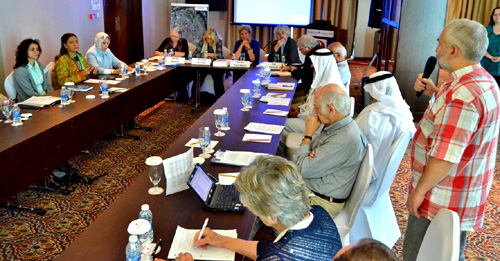
The 5th International NGO Forum on World Heritage at Risk
Ramada City Center Hotel, Manama, 22 – 23 June 2018
Hanaé Damour graduated from the European School of Political and Social Sciences (ESPOL) in Lille, France, with a Bachelor’s degree in Politics, Philosophy and Economics. She is currently pursuing a Master’s degree in Anthropology and Contemporary Challenges at Paris Nanterre University. Born and raised on Réunion Island, she grew up in a multicultural environment that fostered her interest in cultural diversity and encouraged her to broaden her perspective beyond Western frameworks. This interest led her to undertake an exchange semester at O.P. Jindal Global University in New Delhi, India, where she studied International Relations in 2025. From 2023 to 2026, she served as Head of Communications for both her university newspaper and its solidarity association, experiences that deepened her interest in the ways communities interact with their social and environmental contexts. Hanaé is particularly interested in the safeguarding of intangible cultural heritage and is committed to developing ethical and rigorous approaches to research and cultural mediation.
Hanaé Damour schloss ihr Studium an der European School of Political and Social Sciences (ESPOL) in Lille, Frankreich, mit einem Bachelor-Abschluss in Politik, Philosophie und Wirtschaftswissenschaften ab. Derzeit absolviert sie einen Masterstudiengang in Anthropologie und zeitgenössischen Herausforderungen an der Universität Paris Nanterre. Geboren und aufgewachsen auf der Insel La Réunion, wuchs sie in einem multikulturellen Umfeld auf, das ihr Interesse an kultureller Vielfalt weckte und sie dazu ermutigte, ihren Blickwinkel über westliche Rahmenbedingungen hinaus zu erweitern. Dieses Interesse veranlasste sie 2025 zu einem Austauschsemester an der O.P. Jindal Global University in Neu-Delhi, Indien, wo sie Internationale Beziehungen studierte. Von 2023 bis 2026 war sie als Kommunikationsleiterin sowohl für ihre Universitätszeitung als auch für deren Solidaritätsverein tätig – Erfahrungen, die ihr Interesse daran vertieften, wie Gemeinschaften mit ihrem sozialen und ökologischen Umfeld interagieren. Hanaé interessiert sich besonders für den Schutz des immateriellen Kulturerbes und setzt sich für die Entwicklung ethischer und fundierter Ansätze in der Forschung und Kulturvermittlung ein.
I am studying MA World Heritage Studies at BTU Cottbus-Senftenberg, Germany, and searching for opportunities across Europe to thrive as a young Heritage professional. Coming to Germany from Nepal with a background in Architectural Design and high hopes of bringing change back to his country, Sumin is still discovering how to best apply his knowledge and experience.
Growing up to the toll of temple bells in a very tradition-based society, he seeks to empower people to preserve and protect their heritage by placing community at the core of cultural heritage management. On any ordinary day, you will find him spending time with his friends and Cottbus family, meditating, taking photographs, and enjoying nature.
Ich studiere im Masterstudiengang „World Heritage Studies“ an der BTU Cottbus-Senftenberg in Deutschland und bin europaweit auf der Suche nach Möglichkeiten, mich als junger Fachmann im Bereich Kulturerbe weiterzuentwickeln. Sumin kam aus Nepal nach Deutschland – mit einem Hintergrund im Bereich Architekturdesign und der großen Hoffnung, in seinem Heimatland Veränderungen herbeizuführen. Noch immer ist er dabei herauszufinden, wie er sein Wissen und seine Erfahrungen am besten einsetzen kann. Aufgewachsen in einer sehr traditionsbewussten Gesellschaft, in der der Klang von Tempelglocken den Alltag prägte, möchte er Menschen dazu befähigen, ihr Kulturerbe zu bewahren und zu schützen, indem er die Gemeinschaft in den Mittelpunkt des Kulturerbe-Managements stellt. An einem ganz normalen Tag verbringt er seine Zeit mit seinen Freunden und seiner Cottbuser Familie, meditiert, fotografiert und genießt die Natur.
Henning Frase is a Graduate Engineer (University of Applied Sciences) and works as a freelance architect and expert for damage to buildings, mainly in Berlin and Lower Saxony. Through years of work as an architect as well as an expert in the field of recording structural damage and the associated restoration and repair of structural facilities, he became closely associated with the city of Goslar and helped establish the “Initiativgruppe Altstadt Goslar”, a citizen’s group initiative for the preservation of the historic urban fabric. He came to author several reports for WHW regarding issues of urban development, tourism pressure, and the preservation of cultural significance. Contact: h.frase-architekt@email.de
Henning Frase ist Diplom-Ingenieur und arbeitet als freiberuflicher Architekt und Sachverständiger für Bauschäden, vor allem in Berlin und Niedersachsen. Durch seine langjährige Tätigkeit als Architekt sowie als Sachverständiger im Bereich der Erfassung von Bauschäden und der damit verbundenen Sanierung und Instandsetzung von baulichen Anlagen ist er eng mit der Stadt Goslar verbunden und hat die „Initiativgruppe Altstadt Goslar“ mitbegründet, eine Bürgerinitiative zur Erhaltung des historischen Stadtgefüges. Er verfasste mehrere Berichte für WHW zu Themen der Stadtentwicklung, des touristischen Drucks und der Erhaltung kultureller Bedeutung.
Hiltrud Breyer holds a diploma in Political science from Saarland University and the Frein Universität Berlin. In 1989 she became a founding member of Alliance 90/ The greens in Saarland, and worked as a Member of the European Parliament from 1989 to 2009 and again from 2013 to 2014. She was politically involved in environmental protection, chemical safety regulation, biotechnology governance, public health and gender equality. Since then, she has been a member of the advisory/support network at “Coordination gegen BAYER-Gefahren” and broader EU civil society platforms where she advocates for chemical safety and regulation in the agrochemical sector.
Hiltrud Breyer hat ein Diplom in Politikwissenschaft von der Universität des Saarlandes und der Freien Universität Berlin. 1989 wurde sie Gründungsmitglied von Bündnis 90/Die Grünen im Saarland und war von 1989 bis 2009 sowie erneut von 2013 bis 2014 Mitglied des Europäischen Parlaments. Sie engagierte sich politisch in den Bereichen Umweltschutz, Chemikaliensicherheit, Biotechnologie, öffentliche Gesundheit und Gleichstellung der Geschlechter. Seitdem ist sie Mitglied des Beratungs- und Unterstützungsnetzwerks der „Koordination gegen BAYER-Gefahren“ sowie weiterer zivilgesellschaftlicher Plattformen auf EU-Ebene, wo sie sich für Chemikaliensicherheit und Regulierung im Agrochemiesektor einsetzt.
Martin Lenk holds a degree in geography with minors in landscape ecology and Slavic studies from the University of Greifswald, Germany. He studied abroad in Russia, Kazakhstan, and Spain, and contributed to the World Heritage nomination of “Saryarka – Steppe and Lakes of Northern Kazakhstan.” From 2018 to 2022, he coordinated the World Heritage nomination of Hin Nam No National Park at the Lao PDR’s Ministry of Information, Culture, and Tourism. He is a member of the German Society for Nature Conservation and has served on the board of World Heritage Watch since early 2025.
Martin Lenk hat einen Abschluss in Geografie mit den Nebenfächern Landschaftsökologie und Slawistik von der Universität Greifswald. Er absolvierte Auslandsstudienaufenthalte in Russland, Kasachstan und Spanien und war an der Welterbe-Nominierung von „Saryarka – Steppe und Seen Nordkasachstans“ beteiligt. Von 2018 bis 2022 koordinierte er die Welterbe-Nominierung des Hin Nam No-Nationalparks im Ministerium für Information, Kultur und Tourismus der Demokratischen Volksrepublik Laos. Er ist Mitglied des Naturschutzbundes Deutschland und seit Anfang 2025 Vorstandsmitglied von World Heritage Watch.
Uli Gräbener is a biologist with extensive experience in nature conservation, biosphere reserves, World Natural Heritage, and sustainable resource use. He began his career with NABU’s Russian World Heritage Programme before joining the UNESCO Moscow Office, where he worked on biosphere reserves and World Natural Heritage. He later spent ten years with WWF Germany, focusing on project development, monitoring, evaluation, quality management, and conservation effectiveness. He then served as CEO of the Michael Succow Foundation and helped establish the Biosphere Reserves Institute at HNEE. Today, he is Senior Director, Global Development of the conservation NGO Rare, and Executive Director of Rare Europe.
Uli Gräbener ist Biologe und verfügt über umfangreiche Erfahrung in den Bereichen Naturschutz, Biosphärenreservate, Weltnaturerbe und nachhaltige Ressourcennutzung. Er begann seine Karriere beim russischen Weltnaturerbe-Programm des NABU, bevor er zum UNESCO-Büro in Moskau wechselte, wo er sich mit Biosphärenreservaten und dem Weltnaturerbe befasste. Anschließend verbrachte er zehn Jahre beim WWF Deutschland, wo er sich auf Projektentwicklung, Monitoring, Evaluierung, Qualitätsmanagement und die Wirksamkeit von Naturschutzmaßnahmen konzentrierte. Anschließend war er als Geschäftsführer der Michael-Succow-Stiftung tätig und half beim Aufbau des Instituts für Biosphärenreservate an der HNEE. Heute ist er Senior Director für globale Entwicklung der Naturschutzorganisation Rare und Geschäftsführer von Rare Europe.
Stephan Doempke, born 1955 in Muenster, Germany, studied psychology, cultural anthropology and science of religions in Muenster, Wichita/Kansas and Berlin. His experience in 1978/79 with the spiritual leaders of the Tsistsistas (“Southern Cheyenne”) in Oklahoma led to his decision to commit himself to the preservation of the lands and cultures of indigenous peoples, first of all in North America and the Pacific. In 1989 he joined the founding team at the House of World Cultures in Berlin, and from 1993-1998 coordinated projects in Russia and Central Asia for the German Nature Conservation Union NABU. Later he supported the revitalization of felt-making by nomadic pastoralists in Kyrgyzstan and Mongolia, and was a free-lance consultant with assignments in Ethiopia, Kyrgyzstan, Tajikistan and Montenegro. In 2008 he became UN Programme Coordinator for Culture and Heritage in Albania, and continued his work in Albania as a GIZ expert for UNESCO World Heritage in Gjirokastra. After his return to Berlin in 2014, he founded World Heritage Watch whose chair he has been since then.
Stephan Doempke, geboren 1955 in Münster, studierte Psychologie, Kulturanthropologie und Religionswissenschaft in Münster, Wichita (Kansas) und Berlin. Seine Erfahrungen in den Jahren 1978/79 mit den spirituellen Führern der Tsistsistas („Southern Cheyenne“) in Oklahoma führten zu seiner Entscheidung, sich für den Erhalt der Länder und Kulturen indigener Völker einzusetzen, vor allem in Nordamerika und im Pazifik. 1989 gehörte er zum Gründungsteam des Hauses der Kulturen der Welt in Berlin und koordinierte von 1993 bis 1998 Projekte in Russland und Zentralasien für den Naturschutzbund NABU. Später unterstützte er die Wiederbelebung der Filzherstellung durch nomadische Hirten in Kyrgystan und der Mongolei und war als freiberuflicher Berater mit Einsätzen in Äthiopien, Kyrgystan, Tadschikistan und Montenegro tätig. Im Jahr 2008 wurde er UN-Programmkoordinator für Kultur und Kulturerbe in Albanien und setzte seine Arbeit in Albanien als GIZ-Experte für das UNESCO-Weltkulturerbe in Gjirokastra fort. Nach seiner Rückkehr nach Berlin im Jahr 2014 gründete er World Heritage Watch, dessen Vorsitzender er seitdem ist.
Maritta Koch-Weser is Cofounder and President of World Heritage Watch. She has a distinguished career spanning five decades in international development, as anthropologist, environmentalist, and social entrepreneur, with field experience in Latin America, South & East Asia, parts of Sub-Saharan Africa, the Middle East, and Eastern Europe. Since 1980, she worked as one of the World Bank’s first social scientists and held leading managerial positions, most recently as Director for Environmentally and Socially Sustainable Development in the Latin America and Caribbean Region. Subsequently she became Director General of IUCN -The World Conservation Union in Geneva, Switzerland. Since 2001 Maritta Koch-Weser has continued to support strategic innovations in governance for environment and development, as Founder and President of Earth3000, a non-profit organization (www.earth3000.org). Since 2009 she also leads a program focused on the Brazilian Amazon at the Institute for Advanced Studies at Sao Paulo University.
Maritta Koch-Weser ist Mitbegründerin und Präsidentin von World Heritage Watch. Sie blickt auf eine fünf Jahrzehnte umfassende Karriere in der internationalen Entwicklungszusammenarbeit zurück, in der sie als Anthropologin, im Umweltschutz und als Sozialunternehmerin tätig war, in Lateinamerika, Süd- und Ostasien, Teilen Subsahara-Afrikas, dem Nahen Osten und Osteuropa. Seit 1980 war sie als eine der ersten Sozialwissenschaftlerinnen der Weltbank in Führungspositionen tätig, zuletzt als Direktorin für Ökologische und sozial nachhaltige Entwicklung in Lateinamerika und der Karibik. Anschließend war sie Generaldirektorin der IUCN – der Weltnaturschutzunion. Seit 2001 unterstützt Maritta Koch-Weser weiterhin als Gründerin und Präsidentin von Earth3000, einer gemeinnützigen Organisation (www.earth3000.org), strategische Innovationen im Bereich der Umwelt- und Entwicklungspolitik. Seit 2009 leitet sie zudem ein Schwerpunktprogramm für das brasilianische Amazonasgebiet am IEA/ Universität São Paulo.